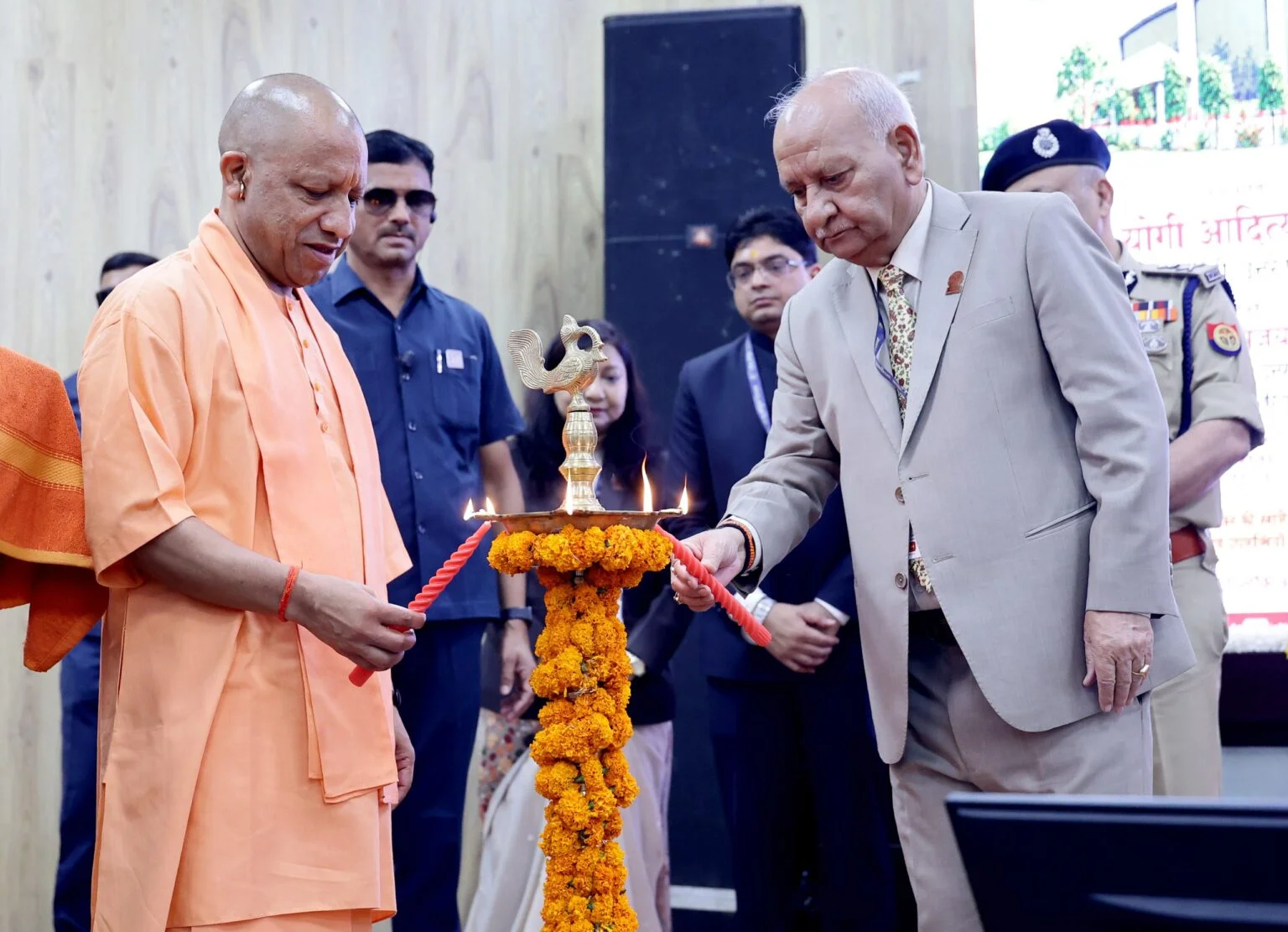
Lucknow: Uttar Pradesh Chief Minister Yogi Adityanath has emphasised that the trust of ordinary citizens in constitutional institutions is the greatest strength of democracy, calling for greater transparency, accountability and technology-driven governance to ensure that public grievances are resolved fairly and efficiently.
Addressing a ceremony organised in Lucknow to mark the 50th Foundation Day of the Lokayukta Organisation, Uttar Pradesh, the Chief Minister said that good governance depended on public trust and that no institution could achieve its objectives without earning the confidence of the people. He stressed that even the person standing at the last rung of society should be able to approach constitutional institutions with dignity and the belief that their problems would receive a fair hearing.

During the programme, Yogi Adityanath released a souvenir and information booklet of the Lokayukta administration and viewed an exhibition and short film highlighting the organisation’s achievements over five decades. Lokayukta Justice Sanjay Mishra, Deputy Lokayuktas Shambhu Singh Yadav, Dinesh Kumar Singh and Surendra Kumar Yadav, Additional Chief Secretary (Home) Sanjay Prasad and Director General of Police Rajeev Krishna were among those present.
The Chief Minister said that the establishment of an institution alone could not guarantee the resolution of public problems. Its real test lay in whether it lived up to the trust placed in it by citizens. Referring to India’s parliamentary democratic system, he said elected representatives were required to return to the people at regular intervals and remain responsive to public sentiment. If representatives failed to retain public confidence, citizens had the democratic right to choose new leadership.
He said that justice, truth and equality were fundamental to the constitutional vision of India. Every individual was entitled to justice without discrimination, and the foundation of justice was truth. Complaints should therefore be examined on their merits, with emphasis on fair disposal and the satisfaction of the complainant.
The Chief Minister highlighted the role of grievance redressal mechanisms such as the Integrated Grievance Redressal System (IGRS), the CM Helpline and Janta Darshan in addressing public complaints within stipulated timelines. He, however, cautioned against the misuse of these platforms by individuals filing unnecessary or false complaints.
Sharing an instance of a complaint against a school that was found to be baseless during an inquiry, Yogi Adityanath said that the complainant subsequently demanded an investigation into all schools in the district. He said such practices wasted the time of the administration and diverted resources away from genuine complainants seeking justice.
The Chief Minister stressed that institutions must exercise their powers responsibly and ensure that decisions were based on facts and merit. At the same time, those who deliberately misused grievance mechanisms should face appropriate scrutiny. He said that public confidence could be strengthened only when citizens believed that their complaints would be heard fairly and resolved through a transparent process.
Yogi Adityanath cited the use of technology in the Public Distribution System (PDS) as an example of how administrative reforms could reduce complaints and improve accountability. He recalled that before 2017, complaints relating to foodgrain distribution accounted for a significant proportion of grievances received during Janta Darshan.
According to the Chief Minister, the introduction of electronic Point of Sale (e-PoS) machines and their integration with monitoring systems at the headquarters helped improve oversight of ration distribution. He said that irregularities at ration shops could now trigger alerts, reducing the scope for manipulation.
He stated that the state was providing ration to approximately 16 crore people without discrimination and that monitoring mechanisms had been strengthened to ensure proper delivery. Trucks transporting foodgrains from Food Corporation of India warehouses to their destinations were also being tracked, he said.
The Chief Minister said that technology had helped address several long-standing issues in the revenue administration, including land disputes, measurement, inheritance and mutation. He claimed that around 34 lakh revenue cases pending in 2017 had been disposed of over the past nine and a half years, although approximately nine lakh new cases had also emerged during the period.
He said that timelines had been fixed for resolving revenue-related matters, including inheritance and land measurement disputes. The government had also introduced accountability provisions for land-use applications, under which failure to resolve certain matters within the prescribed period could result in deemed disposal and responsibility being fixed on the concerned official.
Referring to complaints of inaccuracies in land measurement, the Chief Minister said that technology was being used to make the process more transparent. He stated that robotic equipment had been provided at every tehsil to support accurate measurement and reduce the possibility of manipulation.
Under the technology-based system, land measurement would be carried out using coordinates, allowing landowners to receive a more precise assessment of their property boundaries. The Chief Minister said such measures would help eliminate disputes arising from manual measurement and strengthen confidence in the revenue administration.

Yogi Adityanath said that technology could provide effective solutions to the growing burden of public complaints. He noted that the Lokayukta Organisation played an important role in examining complaints on merit, even in situations where there might be attempts to protect public servants from scrutiny.
He said that public servants must remain committed to ethical conduct and the protection of constitutional values. While institutions should protect the rights and dignity of officials, misuse of authority and irresponsible conduct could not be permitted. He stressed that the powers entrusted to institutions must be exercised in accordance with law, fairness and public interest.
The Chief Minister also spoke about the history of the Lokayukta Organisation in Uttar Pradesh. He said that the organisation formally began functioning in the state on September 14, 1977, in the aftermath of the Emergency. Justice Vishambhar Dayal provided leadership to the organisation in its initial phase.
Yogi Adityanath said that the organisation’s journey had continued under the leadership of Lokayukta Justice Sanjay Mishra, who had helped give it a renewed identity and visibility. He described the completion of 50 years as an opportunity to reflect on the institution’s contribution to public accountability and examine the road ahead.
Highlighting the importance of technology in governance, the Chief Minister referred to the use of artificial intelligence, data analysis, cybersecurity and e-governance in strengthening administrative systems. He said technology should become a means of public welfare and help make government services more transparent, efficient and accessible.
He also cited the Direct Benefit Transfer (DBT) system as an example of how technology could reduce the role of intermediaries and ensure that benefits reached intended beneficiaries directly. Referring to the welfare of widows, elderly persons and other vulnerable groups, he said that the state was transferring annual pensions of ₹12,000 directly into the bank accounts of approximately 1.10 crore beneficiaries.
The Chief Minister said that the expansion of digital systems had helped address concerns relating to leakages and corruption in the delivery of government benefits. He emphasised that the true test of democracy was whether citizens received what was rightfully due to them.
Referring to the broader democratic framework, Yogi Adityanath said that democracy was government of the people, by the people and for the people. He stressed that the credibility of public institutions depended on their ability to serve citizens fairly and maintain their confidence.
The Chief Minister called upon the Lokayukta Organisation to prepare a comprehensive presentation documenting its 50-year journey. He suggested that the organisation compile details of the number of complaints received, cases disposed of and action taken in significant matters, creating a record of its institutional contribution.
He also proposed organising a major programme bringing together Lokayuktas from across the country, along with Lokpal members and other stakeholders. Such a gathering, he said, would provide an opportunity to share best practices, discuss common challenges and strengthen coordination among institutions responsible for public accountability.
Yogi Adityanath underlined the importance of dialogue in strengthening democracy and expressed hope that the Lokayukta Organisation would develop a clear roadmap for the next 50 years through consultations and institutional exchanges.
He assured the organisation of the state government’s continued support for positive initiatives aimed at strengthening transparency, accountability and good governance.
The ceremony marked five decades of the Lokayukta Organisation’s functioning in Uttar Pradesh while placing public trust, technology-driven administration and ethical governance at the centre of the state’s institutional priorities. The Chief Minister’s address also highlighted the need for constitutional institutions to remain accessible, accountable and responsive to the concerns of ordinary citizens.




 ---------------------------------------------------------------------------------------------------